
Last updated: September 2026 · Reading time: 13 min · By the Best Web Developer team
Quick answer
A dentist website converts when a patient can find the right treatment, trust the dentist and book in under a minute on a phone. Build one page per treatment, show real dentist profiles, prices or price ranges, insurance accepted and reviews, and put a sticky booking and WhatsApp button on every page. Load in under 2.5 seconds and track every booking.
Key takeaways
- Most dental patients arrive on mobile from Google Maps or a “dentist near me” search, so the first screen must work one-handed.
- Separate treatment pages (implants, aligners, whitening, children’s dentistry) outrank and outconvert one long “services” page.
- Trust signals decide the booking: named dentists with licence details, clear pricing, insurance lists and genuine reviews.
- In our projects, well-built clinic sites convert 4–9% of visitors into booking requests, against 1–2% for typical template sites.
- A bilingual clinic site in Saudi Arabia typically costs SAR 25,000–90,000, and patient data must be handled under the PDPL.
Why most dental sites look good but fill few chairs
Most dental sites fail because they are designed as brochures, not booking tools. A new dentist website often has beautiful photos of the reception area, yet hides the phone number, lists 30 treatments on one page and sends every enquiry to a generic contact form nobody answers until the next day.
A converting dentist website is a clinic website built around one measurable action, usually a booked appointment, with every page, button and message designed to move a patient toward it. Design still matters, but only as far as it builds trust and removes friction.
This guide walks through the structure, pages, trust signals, booking flow and tracking we use when building clinic sites. The examples lean on Saudi Arabia, where bilingual content, WhatsApp booking and insurance questions shape patient behaviour, but the method works in any market.
Note: healthcare advertising rules
Healthcare marketing is regulated in most countries. In Saudi Arabia, clinics are licensed by the Ministry of Health and practitioners are registered with the Saudi Commission for Health Specialties, and rules can apply to claims, before-and-after images and promotional offers. This article is general information, not legal or regulatory advice. Check current requirements with the relevant authority or your compliance adviser before publishing.
The dentist website structure that converts
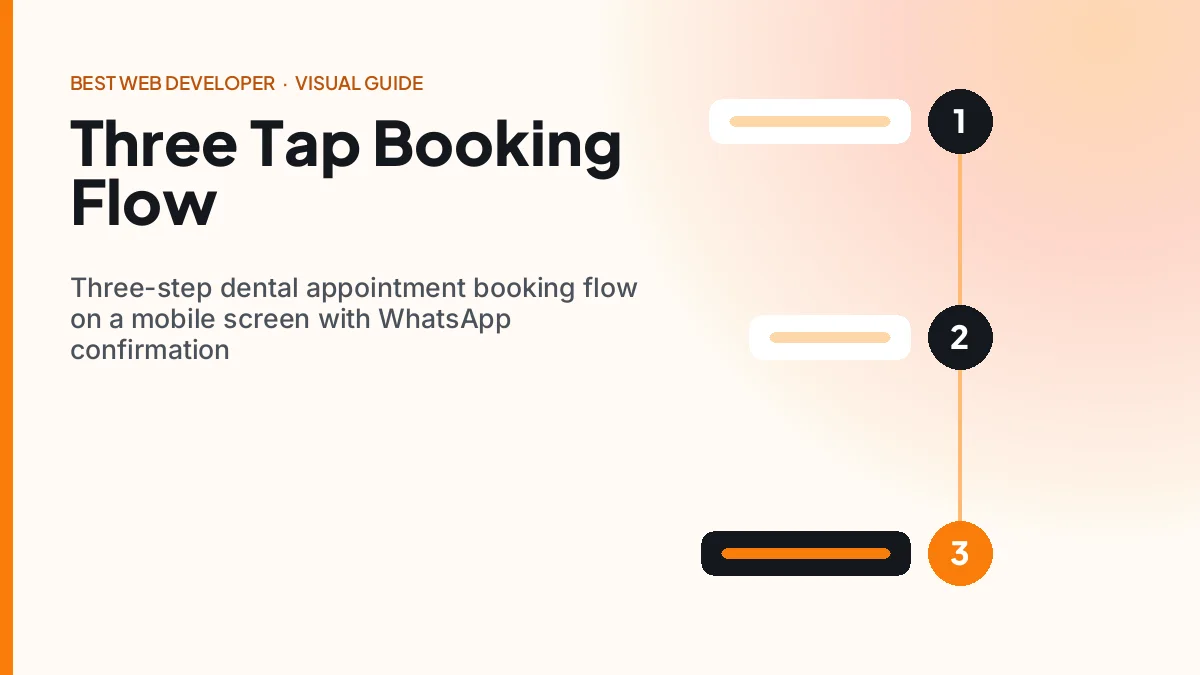
The best-converting structure is simple: a clear homepage, one page per treatment, one page per dentist, one page per branch, and a booking flow that never takes more than three taps. Everything else supports those pages.
The first screen: answer three questions
On a 390px-wide phone, the top of your homepage should show what you treat, where you are and how to book. A strong headline might read “Family and cosmetic dentistry in Al Olaya, Riyadh”, followed by the opening hours today, a star rating with review count, and two buttons: “Book an appointment” and “WhatsApp us”. Save the clinic tour video for further down.
One page per treatment
Patients search for specific treatments: “dental implants cost”, “clear aligners Riyadh”, “teeth whitening price”. Each high-value treatment deserves its own page with a plain explanation, who it suits, how many visits it takes, a price or price range, financing options, FAQs and a booking button. In our experience, implant, aligner and veneer pages generate most of the revenue, so write those first and write them best.
Dentist profiles that build trust
A patient choosing an implant surgeon wants to know who will treat them. Give each dentist a page with a professional photo, qualifications, registration details where permitted, languages spoken, years of practice, special interests and the days they work at each branch. Female dentist availability is a genuine decision factor for many Saudi families, so show it clearly.
Branch pages for local search
Each branch needs its own page with the full address, a map, parking notes, opening hours including Ramadan hours, a phone number and the dentists who work there. These pages feed Google Business Profile and local rankings, and they stop patients driving to the wrong branch in Jeddah traffic.
Highlight: the eight pages every dental clinic needs
1) Homepage. 2) Treatment pages for your top five procedures. 3) Dentist profiles. 4) Branch pages. 5) Prices and insurance. 6) Patient reviews and results. 7) New patient information (first visit, what to bring, payment). 8) Booking page with confirmation. A dentist website with these eight covers more than 90% of what patients look for before booking, in our audit experience.
Building the booking flow: our seven-step process
A booking flow converts when it asks for the minimum, confirms instantly and follows up automatically. We build it in seven steps, and each one removes a reason to abandon.
- Map the patient journeys. List the five most common reasons people book: check-up, pain or emergency, cleaning, cosmetic consultation, children’s visit. Each gets its own entry point.
- Choose the booking model. Real-time slots from your practice management system are best. If that is not possible, use a short request form plus WhatsApp confirmation within 15 minutes during opening hours.
- Cut the form to five fields. Name, mobile, treatment, preferred branch and preferred time. Ask insurance details later, by message.
- Add a sticky mobile bar. Three buttons fixed at the bottom of the screen: Call, WhatsApp, Book. Make each tap target at least 44 by 44 pixels.
- Confirm instantly. Show an on-screen confirmation and send an SMS or WhatsApp message with date, branch location pin and preparation notes.
- Automate reminders. Send reminders 24 hours and 2 hours before the visit. In our projects this cuts no-shows by roughly a third.
- Track every step. Record form starts, form submissions, calls from the site and WhatsApp clicks as separate conversions in your analytics.
WhatsApp as the second booking channel
In Saudi Arabia many patients prefer to message rather than call or fill a form. A WhatsApp Business account connected to the site, with quick replies for prices, location and available times, can handle a large share of enquiries. Our WhatsApp bot development service can answer common questions in Arabic and English after hours and pass hot leads to reception in the morning.
Pro tip
Add a “Dental pain today?” button on the homepage that goes straight to same-day slots or a direct phone line. Emergency patients convert at a far higher rate than cosmetic browsers and often become long-term family patients.
Trust, speed and local SEO for a dentist website
Patients book with the clinic they trust and can find. That means visible proof, clear prices, a fast site and strong local search signals working together.
Prices and insurance, stated plainly
Price is the most searched question in dentistry and the one clinics most often avoid. Publish “from” prices or ranges, for example “Scaling and polishing from SAR 250” or “Single implant SAR 4,500–8,000 depending on assessment”. List the insurance providers you accept and explain whether they are direct billing. If you offer Tabby or Tamara instalments for cosmetic work, say so on the relevant treatment pages, because splitting a SAR 12,000 aligner plan into four payments changes the decision.
Reviews and results you are allowed to show
Embed genuine Google reviews and short patient stories, with written consent. Before-and-after galleries are persuasive, but check local advertising rules and patient consent first, and never edit results. A dentist website with 300 real reviews at 4.7 stars will outconvert one with a perfect 5.0 from 12 reviews, because patients distrust perfection.
Speed and technical quality
A patient in pain will not wait for a slow page. Aim for Google’s Largest Contentful Paint target of 2.5 seconds or less on mobile, compress clinic photos to WebP or AVIF, and avoid heavy video on the first screen. Keep INP at or under 200 milliseconds so the booking form responds instantly.
Structured data and local signals
Mark up each branch with Dentist schema (a type of LocalBusiness), including address, opening hours, phone and geo-coordinates, and add FAQPage markup to treatment pages. Google explains how this works in its structured data introduction. Our free schema generator builds valid JSON-LD for a clinic in a few minutes. Keep the name, address and phone identical across the site, Google Business Profile and directories.
Key benefits of a conversion-focused clinic site
A conversion-focused site turns existing traffic into booked chairs before you spend another riyal on ads. The gains compound because every improvement also lowers your cost per patient from paid campaigns.
- More bookings from the same traffic: moving from 1.5% to 5% conversion more than triples appointments without extra spend.
- Lower ad costs: landing pages matched to each treatment improve Google Ads quality and reduce cost per booking.
- Higher-value patients: clear implant, aligner and veneer pages attract patients ready for larger treatment plans.
- Less reception load: prices, insurance and preparation answers online reduce repetitive calls.
- Fewer no-shows: automated confirmations and reminders protect chair time.
- Better data: you know which treatment, branch and channel produce revenue, not only clicks.
“A dental patient decides in seconds. If your price, your dentist and your booking button are not visible on the first screen, the next clinic on the map wins.”
— Best Web Developer strategy team
Use cases: dental clinics in Saudi Arabia
Dental clinics in Saudi Arabia need Arabic-first content, WhatsApp booking, insurance clarity and PDPL-compliant handling of patient data. The mix differs by clinic type, so plan the site around your patient profile.
Multi-branch groups in Riyadh, Jeddah and Dammam
Groups need a branch finder, dentist schedules per branch and central booking that routes to the right reception team. Each branch page should target its district, such as Al Malqa or Al Rawdah, because local searches are highly specific. Our local SEO services cover branch pages and Google Business Profile optimisation together.
Cosmetic and aesthetic dentistry
Cosmetic clinics sell outcomes and confidence. They need strong treatment pages, consultation booking, financing through Tabby or Tamara, and campaigns timed for high-demand periods such as the weeks before Eid and the wedding season. Video consultations can qualify patients from other cities before they travel.
Protecting patient data under the PDPL
Health information is sensitive data under the Personal Data Protection Law, which SDAIA enforces and publishes on its regulations and policies page. Collect only what the booking needs, show a clear privacy notice in Arabic and English, restrict who can see form submissions, and check where your form tool and booking software store data. Never send full medical histories through a website form.
Illustrative case: a three-branch dental group in Riyadh
Challenge: The group’s English-only site had one “Services” page, a 5.8 s mobile LCP and a contact form checked once a day. About 6,000 monthly visits produced roughly 70 booking requests, a 1.2% conversion rate.
What we did: We rebuilt it as an Arabic-first bilingual dentist website with 11 treatment pages, 14 dentist profiles, three branch pages, a sticky Call / WhatsApp / Book bar and a five-field form linked to WhatsApp confirmations. Budget: SAR 68,000 over 12 weeks.
Result: After four months, mobile LCP was 2.0 s, monthly visits rose to about 7,400 and booking requests reached around 410, a 5.5% conversion rate. No-shows fell from 18% to 11% after automated reminders.
Template vs custom dentist website: costs and trade-offs
A template site is fine for a single-chair practice testing demand. Multi-branch and cosmetic clinics nearly always earn back the cost of a custom build within a year through higher conversion.
| Option | Typical cost (SAR) | Timeline | Best for | Limits |
|---|---|---|---|---|
| Website builder template | 3,000–10,000 plus monthly plan | 2–4 weeks | New single-dentist practice | Weak Arabic RTL, generic look |
| Customised WordPress theme | 15,000–35,000 | 5–8 weeks | One or two branches | Plugin bloat if not managed |
| Custom bilingual build | 35,000–90,000 | 8–14 weeks | Groups and cosmetic clinics | Needs content from dentists |
| Custom build with booking integration | 90,000–180,000 | 3–5 months | Five or more branches | Depends on practice software API |
Prices exclude 15% VAT and reflect typical ranges we quote for clinics in the Kingdom. Add SAR 1,500–5,000 a month for hosting, updates and content if you want the site kept current. See our healthcare and clinics page for how we scope medical projects.
Highlight: the payback calculation
If an average new patient is worth SAR 1,800 in the first year and a rebuild adds 40 extra bookings a month with a 70% show rate, that is 28 new patients and about SAR 50,000 of first-year value every month. Even at half that figure, a SAR 68,000 dentist website pays back in under three months.
Dental web trends for 2027 and Vision 2030 healthcare goals
Vision 2030’s health transformation is pushing private clinics toward digital booking, better patient experience and data discipline. Clinic websites will be judged by how well they integrate with that wider system.
- AI answers for treatment questions: patients now ask chat assistants “how much are implants in Riyadh”. Clear, structured treatment pages are more likely to be cited in those answers.
- Online pre-registration: digital intake forms and insurance checks before the visit shorten waiting times.
- Conversational booking: WhatsApp and voice agents that book, reschedule and remind without reception staff.
- Accessibility: older patients and people with disabilities need readable fonts, strong contrast and keyboard-friendly forms, in line with WCAG 2.2.
- Medical tourism: clinics in major cities are starting to attract patients from across the Gulf, which calls for English content and clear travel information.
Frequently Asked Questions about dental clinic websites
What should a dentist website include?
A dentist website should include a clear homepage, separate pages for the main treatments, dentist profiles with qualifications and languages, branch pages with maps and hours, a prices and insurance page, genuine patient reviews, new patient information and a short booking form. Add a sticky mobile bar with call, WhatsApp and booking buttons so patients can act from any page.
How much does a dental clinic website cost in Saudi Arabia?
Typical ranges before 15% VAT are SAR 3,000–10,000 for a website builder template, SAR 15,000–35,000 for a customised WordPress site, SAR 35,000–90,000 for a custom bilingual build and SAR 90,000–180,000 for multi-branch sites with booking integration. Ongoing hosting, updates and content usually add SAR 1,500–5,000 a month depending on scope.
What is a good conversion rate for a dental website?
In our projects, well-built clinic sites turn roughly 4–9% of visitors into booking requests, calls or WhatsApp enquiries, while basic template sites often sit at 1–2%. The rate depends on traffic source, treatment mix and whether prices are shown. Track form submissions, calls and WhatsApp clicks separately so you know which channel is actually producing appointments.
Should dentists show prices on their website?
Yes, in most cases. Price is one of the most searched dental questions, and clinics that publish “from” prices or ranges usually receive better-qualified enquiries. Show a starting price or range, explain what affects the final cost, list accepted insurance and mention instalment options. Check any local rules on promotional pricing before advertising discounts or special offers.
How do I get my dental clinic to rank in Riyadh?
Create a page for each branch with its district name, address, hours and map, and link it to a fully completed Google Business Profile. Publish detailed treatment pages in Arabic and English, add Dentist and FAQPage schema, collect genuine reviews steadily, and keep your name, address and phone identical everywhere. Fast mobile loading supports rankings and conversions at the same time.
Is WhatsApp booking better than an online form?
Neither replaces the other. Many patients in the Gulf prefer WhatsApp because it feels personal and quick, while others want to pick a slot without talking to anyone. Offer both: a five-field form or live calendar for self-service booking, and a WhatsApp button with quick replies. Respond within 15 minutes during opening hours to keep the conversion rate high.
Does a clinic website need to follow the PDPL?
Yes. If your website collects personal data from people in Saudi Arabia, the Personal Data Protection Law applies, and health information is treated as sensitive data. Collect only what booking needs, publish a clear privacy notice, secure form submissions and limit staff access. Check where booking tools store data. This is general information, so confirm details with a qualified adviser.
Turn your dentist website into a booking engine
A dentist website converts when patients can see what you treat, who will treat them, what it costs and how to book, all within the first few seconds on a phone. Build treatment, dentist and branch pages, cut the booking form to five fields, add WhatsApp, and track every enquiry.
For clinics in Saudi Arabia, add Arabic-first design, insurance clarity and careful handling of patient data. Get those foundations right and every riyal you later spend on ads will work harder.
Want more booked chairs from the traffic you already have?
We will audit your clinic site, estimate your current conversion rate and send a costed plan in SAR within five working days.
Get a free consultation See pricingWant this handled for you?
We build and optimise sites like this every week. Book a free 30-minute call and we will tell you exactly what we would change on yours.
Get a free site review