Legal website development
- Law firm, attorney and solicitor websites
- Practice-area landing pages
- Lawyer profiles and office pages
- Insights and legal resource libraries
- Accessible, responsive interfaces (WCAG 2.2 AA)

Language
No language matches that search.
Currency
Prices on this site are shown in the currency you choose.
Law firms and legal practices
We provide law firm website design, legal SEO and secure client intake for solicitors, attorneys and legal practices in the UK, the US, Saudi Arabia and the Gulf. Practice area pages answer real client questions, enquiries reach the right fee earner fast, and every claim respects your regulator's advertising rules.
Legal technology capabilities
Nine capability areas, delivered as a website, a platform module or an integration with the systems your firm already uses.
Practice, lawyer and office pages built for client searches and conduct rules.
Bespoke tools where off-the-shelf practice software does not fit your workflow.
Role-based dashboards for matters, messages, documents and appointments.
Matter records, deadlines, hearings, tasks and assignments in one view.
Permission-based uploads, categories, version history and audit trails.
Online booking for first consultations, with reminders and calendar sync.
Practice-area content, office pages and Google Business Profile upkeep.
Enquiry triage, document summaries and admin assistants that never give legal advice.
Arabic and English with true right-to-left layouts, plus the other languages your clients speak.
People rarely look for a lawyer on a calm day. They search after a dismissal, an accident, a dispute with a supplier or a letter from the tax authority, and they judge a firm in seconds on whether it clearly handles their problem. Good law firm website design meets that person with a specific answer and an easy, confidential way to get in touch.
We work with high street solicitors, boutique commercial firms, personal injury and immigration practices, US attorneys and Gulf-based law firms that serve both local and international clients. The work covers the website, search visibility, and the intake systems that sit behind the contact form.
A law firm website needs to show a prospective client, within a few seconds, that you handle their exact matter, that your lawyers are credible, and that contacting you is safe and simple. Everything else on the site supports those three jobs.
That means one page per practice area and, for larger firms, per sub-specialism. It means lawyer profiles with admissions, languages and representative work described within the rules. It means transparent information on fees and funding where your regulator expects it. It also means an enquiry flow that gathers enough detail to run a conflict check without asking for privileged information too early.
Most lost instructions never show up in a report. A prospective client lands, cannot confirm you do what they need, and calls the next firm. The causes repeat across practices.
We start with website design and development built on a clear structure: practice areas, locations, lawyers and insights, each with its own page. Most builds use WordPress so your marketing or business development team can publish updates without waiting on a developer.
Local SEO puts each office into map results and legal directories. Search engine optimisation builds practice content around the questions clients actually ask, reviewed by a fee earner before it goes live. We also structure pages for answer engine optimisation, so AI assistants can summarise your services accurately rather than guessing.
For intake, AI lead qualification can sort enquiries by practice area, urgency and jurisdiction, then route them to the right team. An assistant on the website answers practical questions about fees, offices and next steps. It never gives legal advice, and anything about the merits of a matter goes to a qualified lawyer.
In Saudi Arabia, law firms are licensed through the Ministry of Justice, and the Saudi Bar Association sets professional standards. Clients expect Arabic first, and WhatsApp is a normal first contact channel. International firms operating locally usually need bilingual content that explains which matters are handled in the Kingdom. We work with firms in Riyadh and across the Gulf, including Dubai, where DIFC and ADGM courts add their own practitioner rules.
In the UK, the Solicitors Regulation Authority transparency rules shape what fee and service information appears for certain practice areas. In the US, state bar advertising rules vary, and many require disclaimers on results and testimonials. We build the site so each office can carry the right statements for its jurisdiction, working with firms in London and New York.
This is a composite example of a typical project, not a client story. A commercial firm has an office in the UK and one in the Gulf. Its website has a single services page, a generic contact form, and lawyer biographies that have not been updated in years.
The rebuild gives each practice area and each office its own page, with regulatory details shown per jurisdiction. The Gulf office launches in Arabic and English. Enquiries now pass through a structured intake form that asks for the matter type, the other party’s name for conflict checks, and the level of urgency. Each enquiry goes straight to the relevant partner. The firm then reviews instructions by source every month, instead of relying on anecdote.
A law firm website typically costs between £3,000 and £45,000, depending on scope. The biggest cost drivers are the number of practice areas and offices, intake and practice management integrations, bilingual content, and how much lawyer-reviewed copy needs writing. A sole practitioner site with a clear enquiry form sits at the lower end. A multi-office firm with Arabic and English, structured intake and a large insights library sits at the upper end. Ongoing legal SEO is priced monthly. See the ranges below and our pricing page. We give a fixed quote after scoping.
Tell us which matters you want more of and where enquiries currently go cold. We will reply with a scope, a timeline and a fixed price. Book a free consultation, or browse other industries we serve, including accountants and consultants with similar needs.
Who we work with
Each type of practice wins clients differently, so the website and systems follow how that practice works, not a generic template.
A credible site, clear fees and a booking flow one person can run.
Specialist positioning, partner profiles and insight content that earns referrals.
Sector pages, deal experience and a multi-office structure for in-house buyers.
Multilingual eligibility guides, document checklists and secure uploads.
Immigration law websitesFast mobile intake and claims explained without promises the rules forbid.
Discreet design, careful wording and safe ways to make contact.
Matter-type pages, urgency routing and hearing-aware scheduling.
Separate journeys for employees and employers, with time-limit prompts.
Clear explainers, filing services and support for international portfolios.
Authority content, secure document exchange and client portals.
Finance and insurance websitesJurisdiction pages and multilingual content for cross-border clients.
Product sites, onboarding flows and dashboards for legal software.
Office, language and regulator details managed per jurisdiction.
How we help
One page per practice area, office and lawyer, written in plain language and reviewed by a fee earner.
Forms that capture matter type, urgency, jurisdiction and conflict details, routed straight to the right team.
Arabic and English builds with proper right-to-left layout for Gulf offices and international clients.
Google Business Profile, office pages and consistent listings in legal and general directories.
A website and WhatsApp assistant for fees, offices and booking, with every legal question passed to a lawyer.
Templates for regulatory statements, disclaimers and review dates, set per jurisdiction.
Solutions
Choose the modules you need now. Each one is designed to connect to the next, so the platform can grow without a rebuild.
Our AI tools support lawyers and staff. They never present themselves as a lawyer, and any question about the merits of a matter goes to a qualified person.
Legal technology demo concepts
These are working concept demos we built with fictional data to show how legal platforms behave. They are not client projects, and no real person, case or document appears in them.
Illustrative concept
Homepage, practice areas, lawyer profiles and consultation booking for a fictional two-office firm.
Illustrative concept
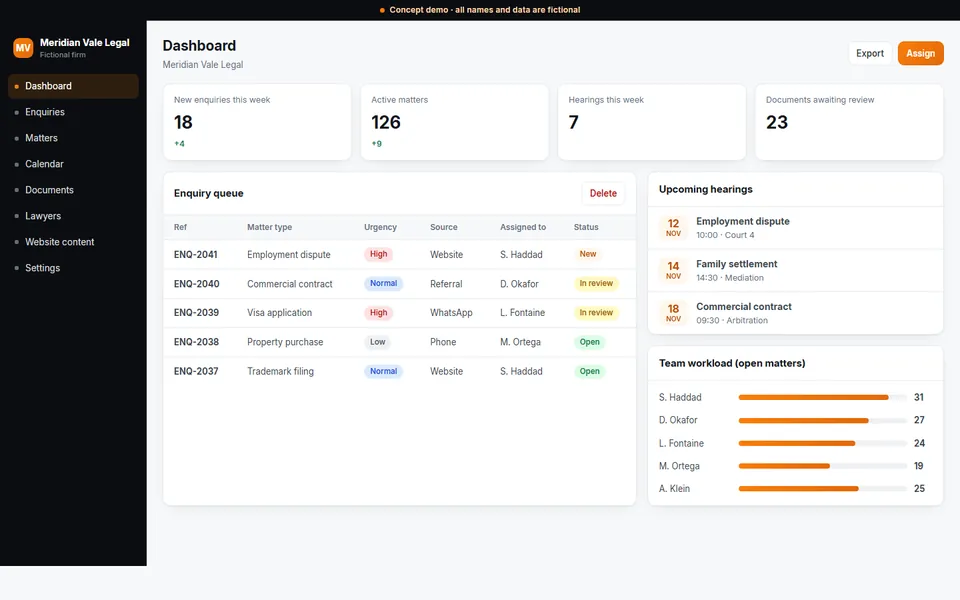
A firm-wide view of new enquiries, active matters, upcoming hearings and team workload.
Illustrative concept
A lawyer's day in one screen: assigned matters, deadlines, hearings and tasks.
Illustrative concept
Clients follow matter progress, share documents securely and book appointments.
Illustrative concept
A matter record with status timeline, parties, notes and the document bundle.
Illustrative concept
Enquiries triaged by practice area and urgency, then checked for conflicts and routed.
Demo stack: lightweight HTML, CSS and JavaScript with fictional data. Production platforms are scoped around your existing systems.
Related work in our portfolio: Business CRM demo · Healthcare booking demo · Education management demo
Concept walkthrough
A worked example of our method, based on the demo concept above. Real engagements follow the same structure, and published case studies include only results the client has approved.
Clients phone and email for updates, and documents arrive as attachments across many inboxes.
One secure place for progress, documents and appointments, with fewer routine status calls.
Website and portal on one platform, single sign-on, role-based permissions and an integration layer for the practice system.
Matter timeline, secure uploads, messages, booking, audit log and an Arabic and English interface.
WordPress or Laravel, encrypted storage, multi-factor authentication and hosting in the region the firm chooses.
Agreed before launch: portal adoption, response times and enquiry-to-instruction rate, reported from the firm's own analytics.
Process
Fixed scope before build, a named engineer throughout, and nothing goes live until you have signed it off.
We map your practice areas, offices, systems and conduct rules, and agree what a new instruction is worth.
We plan every page, draft client-facing copy, and send it to your lawyers for review.
We design, build accessibly, and connect intake and booking to your practice management system.
We test on real devices, set up consent-aware analytics, train your team and launch.
We track enquiries by practice area and source, and keep improving content and visibility.
Pricing
Typical ranges from comparable scopes, not a quote. You get a fixed price in writing after a free scoping call.
| Scope | UK (GBP) | US (USD) | Saudi and Gulf (SAR) | What it covers |
|---|---|---|---|---|
| Sole practitioner or small firm site | £3,000–£7,000 | $3,800–$8,800 | SAR 14,000–33,000 | Core practice pages, lawyer profiles, enquiry form, regulatory details, local SEO setup. |
| Multi-practice firm with structured intake | £7,000–£18,000 | $8,800–$22,500 | SAR 33,000–85,000 | Practice and office pages, intake routing, booking, bilingual content. |
| Multi-office or international firm | £18,000–£45,000 | $22,500–$56,000 | SAR 85,000–210,000 | Several jurisdictions, integrations, insights library and a content approval workflow. |
| Ongoing legal SEO and content | £900–£2,800 per month | $1,100–$3,500 per month | SAR 4,200–13,000 per month | Practice content, local SEO, reporting on enquiries by source. |
Compliance
General guidance, not legal advice. Your own compliance lead or adviser confirms what applies to your organisation.
The SRA Transparency Rules typically require price and service information for certain practice areas, and firms usually display the SRA digital badge. Enquiry forms collect personal data and sometimes special category data, so they are designed for minimal collection. Confirm the detail with your compliance officer.
Most state bars regulate lawyer advertising, including disclaimers on past results, testimonials and specialist claims. State privacy laws such as the CCPA/CPRA may apply to your analytics and forms. Your ethics counsel confirms the position for each state.
Legal practice and its promotion are governed by the Ministry of Justice and Saudi Bar Association rules. The Personal Data Protection Law, overseen by SDAIA, applies to client enquiries and restricts some transfers abroad. Confirm requirements with your adviser.
Firms in DIFC or ADGM follow their own practitioner and data protection regimes, while onshore UAE, Qatar and other Gulf states have separate licensing. We check which rules apply to each office at scoping.
Accessible design is expected under the UK Equality Act and is increasingly enforced in the US under the ADA. We build to WCAG 2.2 AA as standard.
International markets
Terminology, regulators and client expectations differ by market, so we adapt structure, wording and data handling to each one.
Attorney websites with state-by-state office pages, bar advertising disclaimers and US English.
Solicitor websites with SRA transparency information, digital badge placement and UK English.
Arabic-first bilingual sites with right-to-left layouts, WhatsApp contact and PDPL-aware intake.
GDPR-aligned intake, cookie consent and local-language content for firms across the EU and Ireland.
Mobile-first sites built for variable connections, with POPIA, NDPA and Kenyan data protection in mind.
Lawyer and solicitor sites with local terminology, online booking and Privacy Act-aware forms.
This is a technology overview, not legal advice. Jurisdiction-specific statements are always reviewed by the firm or its regulatory adviser before publication.
Services
A website is a sales asset, not a brochure. We design and build sites that load in under two seconds, read clearly on a phone…
Explore serviceWordPress runs a huge share of the web and gets a bad reputation mostly from how it is usually built. Built properly, it is…
Explore serviceFor anyone serving a defined area, the map pack is where the enquiries are. Getting into it is a specific discipline.
Explore serviceRankings only matter if they bring people who buy. We work backwards from revenue to decide which terms are worth chasing.
Explore serviceA growing share of searches end on the results page itself. Answer engine optimisation is about making sure the answer shown is…
Explore serviceA full enquiry inbox is not the same as a full pipeline. Qualification sorts the real opportunities from the noise before anyone…
Explore serviceMost chatbots annoy people because they guess. We build ours to answer from your documented knowledge, and to hand over honestly…
Explore serviceContent works when it answers a question someone is genuinely asking. Everything else is publishing for its own sake.
Explore serviceLegal technology answers
Legal case management software keeps each matter in one record: client details, parties, deadlines, hearings, documents, notes and time. It replaces scattered spreadsheets and inboxes, and it is the system a client portal reads from.
At minimum: multi-factor sign-in, role-based access to each matter, encrypted document upload and download, a progress timeline, messages, appointment booking and an audit log of who viewed or changed what.
Answer the client's exact problem on a practice-area page, show regulatory details and fees openly, keep the form short and route each enquiry to the right lawyer within the hour. Then measure enquiry-to-instruction rate by source every month.
Questions
The things clients actually want to know — costs, timelines, ownership and what happens after launch.
Still not sure?
Ask us anything on a free 30-minute call. No pitch, no obligation.
A law firm website typically costs from £3,000 for a sole practitioner to £45,000 for a multi-office or international firm. Practice areas, offices, intake integrations and bilingual content move the price most. We give a fixed quote after scoping.
Most law firm websites take six to eight weeks from discovery to launch. Larger firms with several jurisdictions and a formal partner approval process usually take three to four months.
It should include a page for each practice area, lawyer profiles with admissions, office details, fee or funding information, regulatory details and a clear, confidential enquiry route. Guides that answer common client questions help both search visibility and trust.
Yes. We set up and maintain a Google Business Profile for each office, build office pages, and keep your name, address and phone details consistent across legal and general directories.
It depends on your regulator. The SRA, US state bars and Gulf authorities each treat testimonials and results differently, and many require disclaimers. We build the site to your rules, and your compliance officer confirms what can be published.
No. Any assistant we build handles practical questions only, such as fees, offices, documents to bring and booking. Questions about the merits of a matter always go to a qualified lawyer.
Yes. We build Arabic and English sites with proper right-to-left layout. Legal content is translated by people and reviewed by your lawyers, not left to machine translation.
Often, yes. Many practice management and case management platforms offer integrations for enquiries and bookings. Where no integration exists, we send structured enquiries by secure email or to your CRM.
Free strategy session
Tell us where you want the business to be in twelve months. We will come back with a costed plan, a realistic timeline, and the numbers we expect to move — no obligation, no jargon.
Talk to a developer
Not a sales team
show prices in USD?
Concept demo with fictional data. Changes are disabled. If the preview does not load, open it in a new tab.
 English