Last updated: October 2026 · Reading time: 14 min · By the Best Web Developer team
Quick answer
A successful e-commerce website in Pakistan offers mobile wallets (JazzCash, Easypaisa), bank cards and bank transfer or Raast alongside cash on delivery (COD), integrates with a courier for booking and tracking, and is built mobile-first. To cut COD returns, confirm orders by WhatsApp or call, show delivery times and charges upfront, and offer a small discount for prepaid orders. A properly built store typically costs PKR 200,000–900,000.
Key takeaways
- Cash on delivery is still expected by many Pakistani shoppers — offer it, but manage the risk.
- Wallets and cards reduce returns; a small prepaid discount nudges customers to pay online.
- Order confirmation by WhatsApp before dispatch is the cheapest way to reduce fake and impulse COD orders.
- Courier API integration saves hours of manual booking and gives customers tracking links.
- Speed and trust signals (return policy, real address, reviews) decide whether first-time buyers complete checkout.
Online shopping in Pakistan has grown fast, powered by cheaper smartphones, mobile wallets and marketplaces. But running your own store is different from selling on a marketplace. You are responsible for payments, delivery, returns and the trust that makes a stranger hand over money to a website they found on Instagram ten minutes ago.
This guide explains how to build an e-commerce website in Pakistan that actually sells: which payment gateways to offer, how to manage cash on delivery without drowning in returns, how courier integration works, what it costs and which platform to choose.
Payment options every Pakistani online store should consider
Pakistani shoppers use a wider mix of payment methods than shoppers in many countries. Your checkout should match how your customers actually pay.
| Method | How it works | Pros | Cons |
|---|---|---|---|
| Cash on delivery (COD) | Customer pays the rider in cash; courier remits to you | Builds trust with first-time buyers; widest reach | Returns, refused parcels, delayed cash flow |
| JazzCash / Easypaisa | Mobile wallet payment via app, OTP or USSD flow | Very common, works without a bank card | Gateway onboarding and fees; occasional failed callbacks to handle |
| Debit / credit cards | Card payment via a bank or payment-service-provider gateway | Familiar to urban and overseas buyers | Lower card ownership in some segments; 3-D Secure friction |
| Bank transfer / Raast | Customer transfers to your account; Raast enables instant transfers | Low fees, instant with Raast | Manual matching unless automated |
Note
International gateways such as Stripe and PayPal have historically not onboarded Pakistan-registered businesses directly. Most local stores use Pakistani banks and licensed payment service providers. Check each provider’s current onboarding rules before you build.
Choosing a payment gateway provider
Compare providers on: supported methods (wallets, cards, Raast), onboarding documents (NTN, SECP registration, bank account), transaction fees, settlement time, plugin quality for your platform, and support responsiveness. Ask for a sandbox account and test every failure case — cancelled payment, timeout, duplicate callback — before going live.
How to reduce cash on delivery returns
COD returns are the hidden cost of Pakistani e-commerce: you pay delivery both ways and the stock is tied up for days. These measures make a real difference:
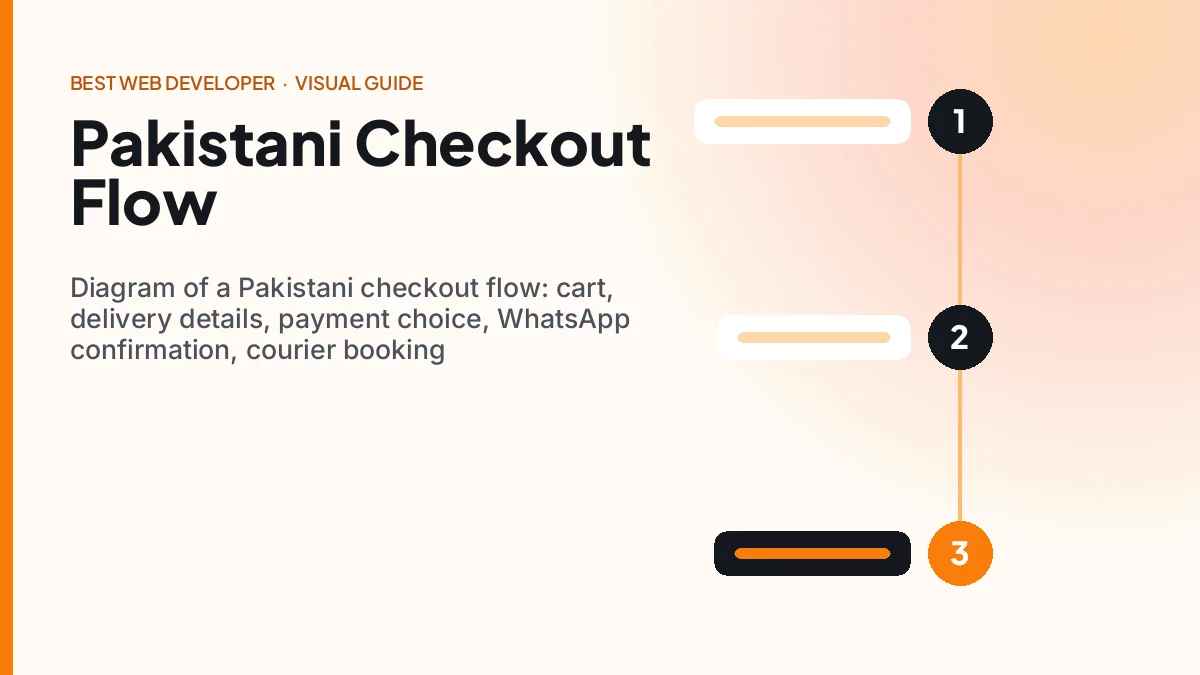
- Confirm every COD order by WhatsApp or phone before dispatch. An automated WhatsApp message with “Confirm / Cancel” buttons is the most efficient option.
- Show the total upfront — product, delivery charge and expected delivery date — before the customer submits the order.
- Offer a prepaid incentive, such as free delivery or a small discount for wallet or card payment.
- Set COD limits by order value or city where returns are high, and require partial advance payment for very large orders.
- Use accurate size guides, real photos and videos so the product that arrives matches expectations.
- Track return reasons and flag repeat refusers in your customer records.
Pro tip
A WhatsApp confirmation step usually pays for itself within weeks. Our WhatsApp bot development service can automate confirmations, order status and delivery updates.
Courier integration, shipping rules and order tracking
Manual courier booking does not scale beyond a few dozen orders a day. Most established Pakistani couriers offer APIs or portals that can be connected to WooCommerce or Shopify. A good integration will:
- Book shipments automatically when an order is confirmed.
- Generate airway bills and labels in bulk.
- Send tracking links to customers by SMS, email or WhatsApp.
- Update order status (dispatched, delivered, returned) on your website.
- Reconcile COD remittances against orders so you know what has been paid.
Set shipping rules by city and weight, and show realistic delivery estimates — for example “2–3 working days in Lahore, Karachi and Islamabad; 3–5 days elsewhere”. Under-promising and over-delivering reduces “where is my order?” messages.
Key benefits of your own store versus marketplace-only selling
- Higher margins — no marketplace commission on every sale.
- Customer data you own — build email and WhatsApp lists for repeat sales.
- Brand control — your design, your story, your packaging experience.
- SEO and AI visibility — product and category pages can rank in Google and be cited by AI shopping answers.
- Flexible pricing and offers — bundles, loyalty discounts and prepaid incentives on your terms.
Marketplaces rent you customers. Your own website lets you keep them.
Use cases: online stores in Pakistan
Illustrative scenarios for common Pakistani store types:
Women’s clothing brand
Seasonal lawn collections create huge traffic spikes. The store needs fast hosting, stock sync, size guides, pre-order handling and COD confirmation. Prepaid discounts during launches reduce returns when demand peaks.
Electronics and accessories seller
Higher order values justify card and wallet payments, warranty information, and partial advance payment for COD. Detailed specification tables help both buyers and AI shopping assistants.
Home-made food and bakery
City-limited delivery, time-slot selection and same-day cut-off times matter more than nationwide courier integration. See our bakery websites page for ideas.
Overseas Pakistani buyers
Stores selling to overseas Pakistanis sending gifts home need international card payments, PKR and foreign-currency display and clear delivery timelines inside Pakistan.
WooCommerce vs Shopify vs custom: which platform suits Pakistan?
| Platform | Local payments | Cost profile | Best for |
|---|---|---|---|
| WooCommerce | Wide choice of Pakistani gateway plugins | Lower monthly cost; you manage hosting | Most Pakistani SMEs and growing brands |
| Shopify | Local gateways via apps and manual methods; check current support | USD subscription plus app fees | Brands wanting a managed platform |
| Custom build | Any integration you need | Highest upfront cost | Large catalogues, marketplaces, unusual workflows |
For a deeper comparison including selling on Daraz, read Shopify vs WooCommerce vs Daraz for Pakistani sellers. Our e-commerce development team builds on all three approaches.
Typical costs
A properly built Pakistani store usually costs PKR 200,000–900,000 depending on catalogue size, integrations and design, plus hosting and maintenance. See the full breakdown in our website cost in Pakistan guide.
Launch checklist for a Pakistani online store
Run through this checklist before you spend a single rupee on ads. Each item prevents a problem we see regularly in new Pakistani stores.
Trust and policies
- A real business address, phone number and WhatsApp number on the contact page and footer.
- Clear delivery, exchange and refund policies written in simple language, linked from every product page.
- Genuine customer reviews or unboxing photos; never invented testimonials.
- A privacy policy explaining what customer data you collect and why — see our website legal checklist for Pakistan.
Checkout and payments
- Every payment method tested end to end in live mode with a small real order, including failed and cancelled payments.
- Guest checkout enabled; account creation optional.
- Phone number validated in Pakistani format so riders can reach the customer.
- Order emails and WhatsApp messages showing order number, total, payment method and expected delivery date.
Performance and SEO
- Product images compressed to WebP and sized correctly; the home page loads in under 2.5 seconds on 4G.
- Unique product titles and descriptions — not copied from the supplier or another store.
- Product schema with PKR price and availability on every product page.
- Google Search Console and analytics installed, with purchase tracking verified.
Operations
- Courier account active, pickup schedule agreed and label printing tested.
- Stock levels synced so customers cannot buy items you no longer have.
- A daily routine for confirming COD orders and answering WhatsApp messages within business hours.
Security basics
Use strong admin passwords with two-factor authentication, keep plugins updated, take daily off-site backups and never store full card numbers on your server — let the payment gateway handle card data.
Future trends: e-commerce in Pakistan to 2030
- Instant payments grow: Raast and wallet-to-merchant payments make prepaid checkout faster, steadily reducing COD dependence.
- Social commerce to website: more brands use Instagram and TikTok for discovery and their own website for checkout and loyalty.
- AI shopping assistants: clear product data, prices and policies become essential for being recommended.
- Cross-border selling: Pakistani brands increasingly sell to the Gulf, where Saudi Vision 2030 and growing online retail create demand for quality textiles, handicrafts and food — requiring multi-currency checkout and international shipping.
Quick win
Add a “Pay online and save delivery” message on product pages. It is one of the simplest ways to shift your payment mix towards prepaid orders.
Frequently asked questions about e-commerce websites in Pakistan
Which payment gateways work in Pakistan?
Most Pakistani online stores use mobile wallets such as JazzCash and Easypaisa, card payments through local banks or licensed payment service providers, bank transfers including Raast, and cash on delivery. Availability and fees change, so confirm each provider’s onboarding requirements and plugin support for your platform.
How much does an e-commerce website cost in Pakistan?
A properly built online store in Pakistan usually costs PKR 200,000–900,000, depending on catalogue size, design, payment and courier integrations. Add hosting, plugin licences and maintenance, typically PKR 60,000–240,000 a year for a growing store.
How can I reduce cash on delivery returns?
Confirm every COD order by WhatsApp or phone before dispatch, show total cost and delivery time upfront, offer a discount or free delivery for prepaid orders, set COD limits for high-value orders, and use accurate photos and size guides so products match expectations.
Can I use Stripe or PayPal in Pakistan?
Stripe and PayPal have historically not onboarded Pakistan-registered businesses directly. Most stores use local banks and licensed payment providers instead. Check the current position with each provider before planning your checkout.
Do I need to register a company to accept online payments?
Payment providers usually require business documents such as an NTN, bank account and, for companies, SECP registration. Requirements differ by provider and business type, so check them early and get advice from a tax professional.
How long does it take to build an online store in Pakistan?
A small store using a proven theme can launch in four to six weeks. Custom-designed stores with payment gateways, courier integration and product data entry usually take eight to twelve weeks. Gateway onboarding and document checks can add time, so start that process early.
Which is the best courier for an online store in Pakistan?
The best courier depends on your cities, parcel size and COD volume. Compare delivery coverage, COD remittance speed, return charges, API or plugin support and customer service. Many stores use two couriers: one for major cities and one with stronger coverage in smaller towns.
Should I sell on Daraz or build my own website?
Many sellers do both: a marketplace for reach and your own website for margin, brand and customer data. Your own site becomes more valuable as repeat customers grow, because you do not pay commission on every sale.
Conclusion: build checkout around how Pakistan pays
An e-commerce website in Pakistan succeeds when its checkout matches local habits: wallets, cards and Raast for those ready to pay online, and cash on delivery managed carefully for everyone else. Add WhatsApp confirmation, courier integration and clear policies, and you protect both conversions and margins.
Start with a fast, mobile-first store, measure your payment mix and return rate every month, and keep nudging customers towards prepaid orders. That is how Pakistani online brands grow profitably, one confirmed and delivered order at a time.
Launch an online store that gets paid
We build Pakistani e-commerce stores with local payment gateways, COD confirmation and courier integration — ready for marketing from day one.
Plan my online storeWant this handled for you?
We build and optimise sites like this every week. Book a free 30-minute call and we will tell you exactly what we would change on yours.
Get a free site review